Environment / Energy
The Future Lifestyle Lives in the Everyday
Professor, Faculty of Environmental Studies / Advanced Research LaboratoriesFURUKAWA Ryuzo

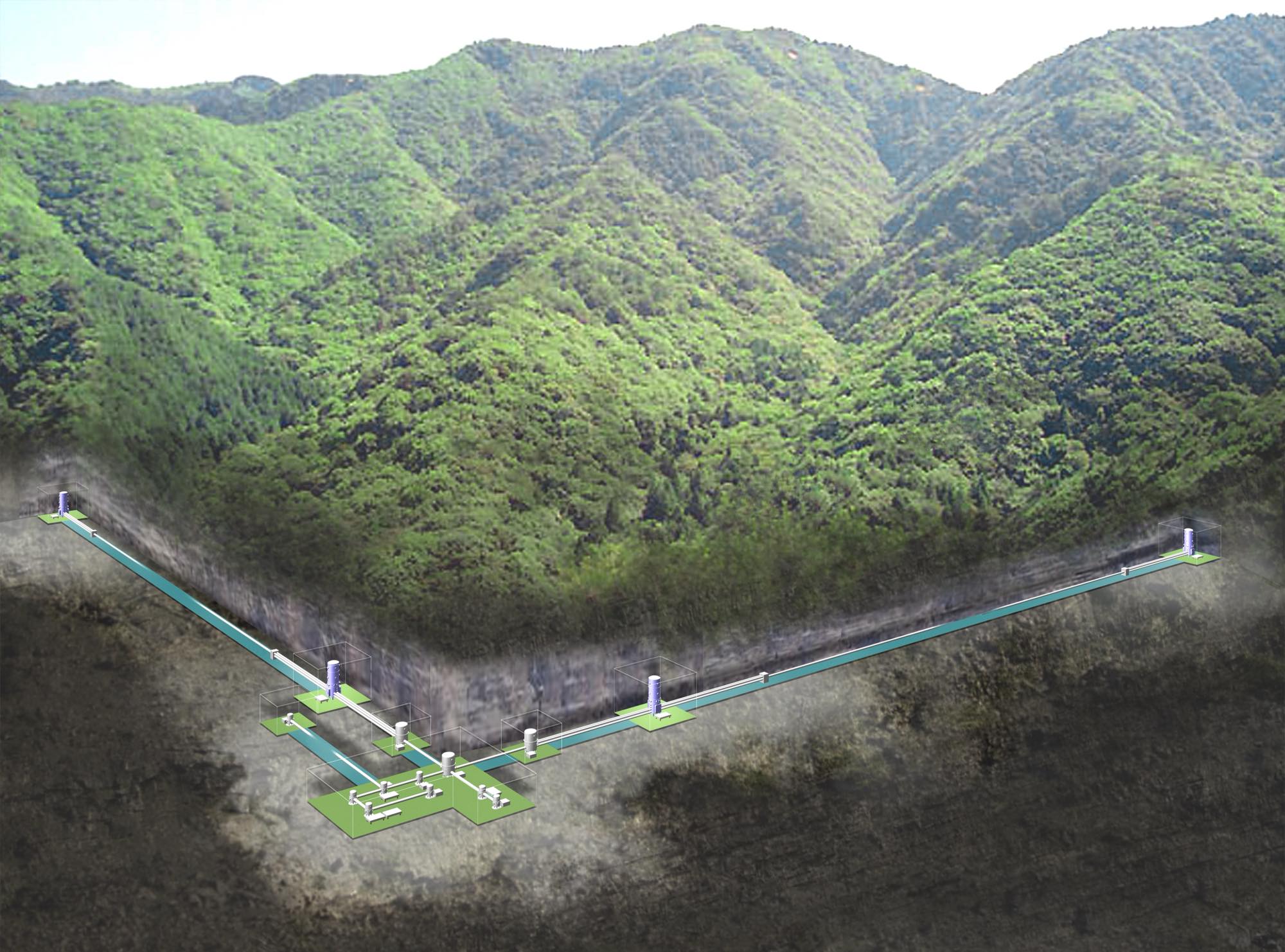
The KAGRA tunnel, where an 80-cm-diameter vacuum duct extends for 3 kilometers. Courtesy of the Institute for Cosmic Ray Research, The University of Tokyo.
All English text on this page has been translated automatically. Some sentences may be unnatural.
Precious materials familiar to us—gold and platinum used in accessories, and rare earth elements that support modern industry—are examples of heavy elements, substances with large atomic masses. Many of these elements are believed to have been created in distant cosmic events known as binary neutron star mergers, where two ultra-dense stellar remnants collide. Behind the materials we use every day lie the grand workings of the universe. It was multi-messenger astronomy, a new approach that examines cosmic events from multiple vantage points, that revealed this astonishing fact. At Tokyo City University’s Institute of Science and Technology, Professor Masatake Ohashi of the Multi-Messenger Laboratory explores these cosmic phenomena and communicates their significance to society.
Professor Ohashi has long been involved with KAGRA, a large cryogenic gravitational-wave observatory. Built underground in the Kamioka Mine of Hida City, Gifu Prefecture, KAGRA began observations on February 25, 2020. The surrounding area hosts several world-leading observational facilities, including the neutrino detectors Super-Kamiokande and KamLAND, and previously the dark matter experiment XMASS. KAGRA’s construction began in 2012, following the project’s launch in 2010. Its L-shaped tunnels extend a total of six kilometers; however, the construction was far from smooth. “As we drilled the tunnels, groundwater continually poured in. The environment was extremely harsh,” recalls Professor Ohashi. Excavation was finally completed in March 2014, after which experimental equipment was installed and test operations conducted, leading to full-scale observations in 2020.

Gravitational waves are ripples in spacetime generated by phenomena such as the merger of compact objects like black holes or the explosive deaths of massive stars known as supernovae. Because the signals are exceedingly faint, even slight vibrations on Earth’s surface can overwhelm them. To avoid such disturbances, KAGRA was constructed 200 meters underground. Its observations rely on a device known as a laser interferometer: laser beams are sent down two perpendicular tunnels, reflected by mirrors at the ends, and recombined to detect interference patterns. When a gravitational wave passes, it subtly changes the optical path lengths, producing a measurable shift in the interference. “Underground vibrations are only about one-hundredth of those at the surface. During the 2024 Noto Peninsula earthquake, some components controlling the mirrors were affected, but all have since been repaired. Because thermal motion can cause noise, the mirrors—made of sapphire—are cooled to −253°C. These measures suppress vibrations as much as possible,” explains Ohashi.
Traditional astronomy relied primarily on observing light (electromagnetic waves). Today, however, we know that the universe sends information through multiple messengers—gravitational waves, cosmic rays, and neutrinos among them. Observing these messengers simultaneously allows researchers to piece together a more complete picture of cosmic events. For example, when two compact stars collide, gravitational waves reach Earth first, followed by gamma rays, X-rays, visible light, and infrared radiation. After detecting a gravitational-wave signal, astronomers determine its likely direction and conduct multi-wavelength observations to search for accompanying electromagnetic emissions. This combined approach forms the basis of multi-messenger astronomy. Alongside KAGRA, three other large gravitational-wave detectors operate worldwide: the two LIGO instruments in the United States and Virgo in Europe. Since LIGO made the first historic detection in 2015, international collaboration has been essential. “To estimate the direction of an incoming gravitational wave, we compare the arrival times at different detectors. Observing from three widely separated locations on Earth is crucial for multi-messenger astronomy,” says Ohashi.
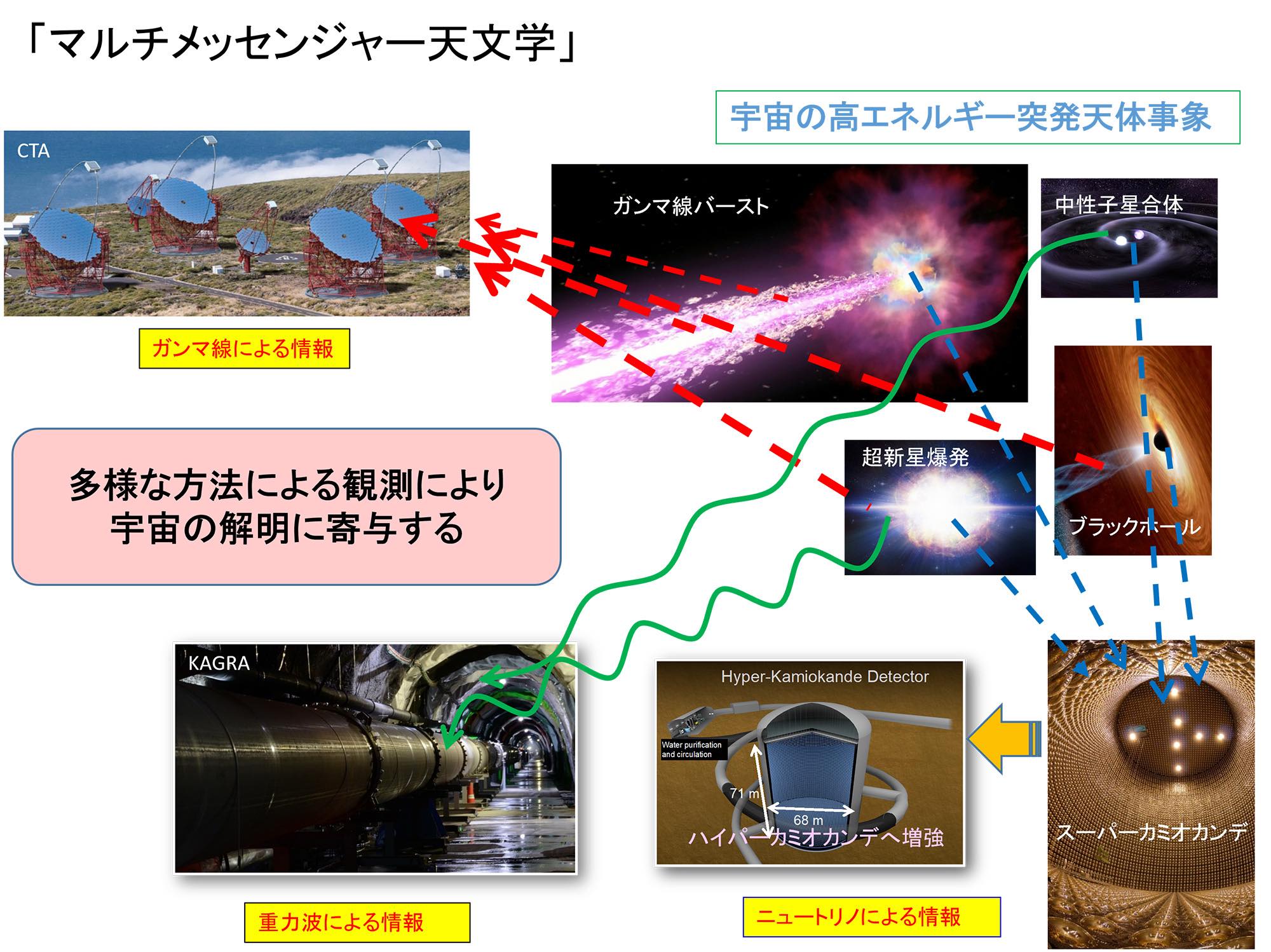
One of the greatest mysteries unlocked by this approach is the origin of heavy elements such as gold and platinum. In 2017, the gravitational-wave event GW170817—produced by merging neutron stars about 140 million light-years away—was detected. Immediately afterward, observatories around the world began coordinated multi-wavelength follow-up observations. The emitted light showed a distinctive evolution in brightness and color over time, identifying it as a “kilonova,” an explosion that forges heavy elements. Analyses suggest that several solar masses’ worth of heavy elements were synthesized during the merger. This was the first time the birthsite of heavy elements had been directly observed, marking the dawn of multi-messenger astronomy. “The 2017 detection was transformative,” reflects Ohashi. “Diamonds are made of carbon and can form on Earth, but precious metals like gold and platinum were created in space and later incorporated into our planet. That idea captures the wonder of what we study.”

Although Professor Ohashi enjoyed astronomy as a child, it was simply a casual hobby. “I became interested in physics during high school, but I truly began studying the universe and gravitational waves in graduate school. A chance encounter with a mentor set me on this path. In experimental physics, to discover what you want to know, you must build the instruments yourself. Because gravitational-wave phenomena are both vast and subtle, the work requires significant time. I lived in Hida City for many years while working on KAGRA, and my interests and lifestyle changed during that period.”
Looking ahead, Professor Ohashi hopes to further expand his outreach activities to share the depth and excitement of gravitational-wave and multi-messenger astronomy. “Conducting experiments and writing papers are important, of course, but communicating the joy of discovery is equally vital. Recently, I visited Hida City to meet with local residents and high school students. I also plan to hold regular events at TCU Shibuya PXU, our university’s public-engagement hub in Shibuya.”
When asked what he values most in his research, his answer resonates strongly with the philosophy of multi-messenger astronomy. “Diversity,” he says. “People are diverse, and so is research. Multiple viewpoints are essential. For example, the strengths of a university can be hard to notice from within, but many become clear when seen from the outside. By placing yourself in diverse environments, you uncover new insights.”

Through international collaboration and the integration of diverse knowledge, our understanding of the Earth and the universe is gradually advancing. Yet countless mysteries remain, each shaped by its own diversity. In this sense, humanity—positioned at the fringe of the cosmic tapestry—may not be so different. Perhaps the key to solving many mysteries lies in perceiving subtle changes and embracing many perspectives.

Professor at the Institute of Science and Technology, Multi-Messenger Astronomy Laboratory, and the Space Science Research Center. He withdrew from the Doctoral Program at the University of Tokyo Graduate School in 1988. He subsequently served as a Research Associate at the National Astronomical Observatory of Japan and as an Associate Professor at the Institute for Cosmic Ray Research (ICRR), the University of Tokyo, before becoming a full Professor at ICRR until 2025. From 2016 to 2024, he also served as Director of the Gravitational-Wave Project Office at ICRR. He joined Tokyo City University in April 2025 and currently holds his present position.